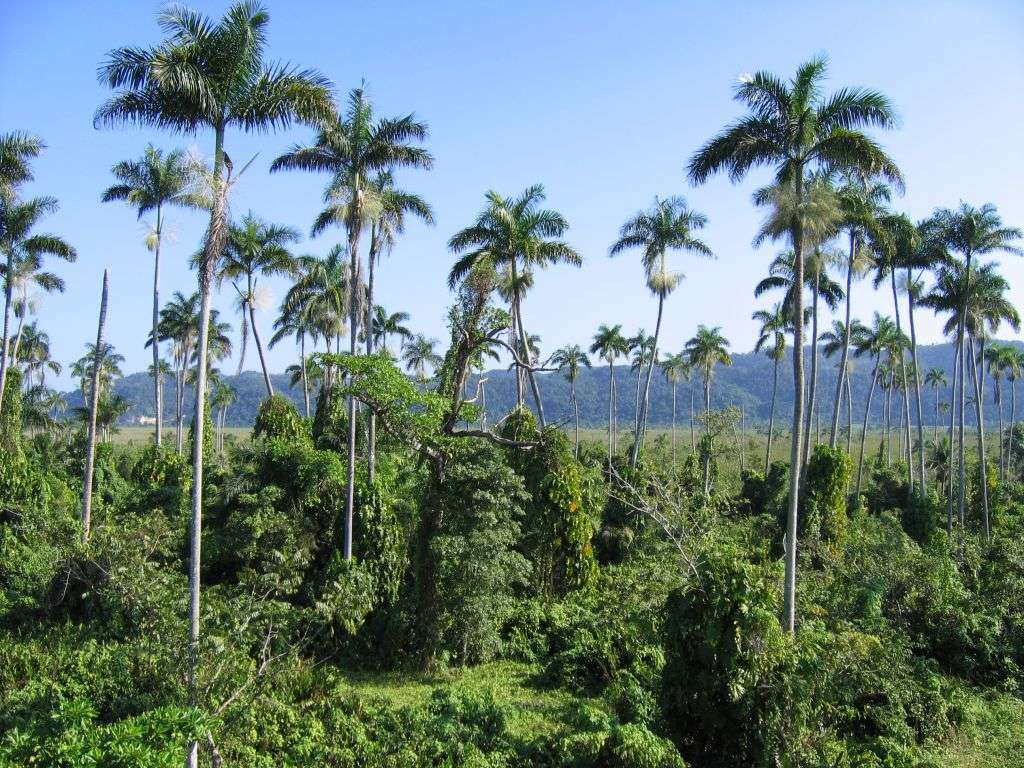
Palm tree tropical jungles of Royal Palms reserve in Negril Jamaica
They nest in nests amongst reeds, mangroves, and ponds, in nest made of reeds, sticks or branches. Both the mom and the father nurture the eggs and after a period of 24 to 26 days the downy young hatches.
Today, one hundred and fourteen plant species including one of the biggest stands of Royal Palms worldwide and over 3 hundred animal species, such birds, butterflies and reptiles can be found at the reserve.
Royal Palm Reserve Birds. Black Crowned Night Heron.
Like the whistling ducks, these herons are nocturnal (feed only in the evening). While their other heron relatives are sleeping, they are up, fending for fish, frogs, crustaceans and other little animals. It is said that they have really strong gastrointestinal acids that dissolve the big bones of their 'catch'. Black crowned night herons are not sweet singers; they make a loud harsh squawk or a loud crockery, crockery.
An environmental study was also performed that year and over three hundred animal species were found, dominated by insects including many butterflies and dragonflies.
Along with a number of species of endemic lizards and frogs in addition to freshwater turtles.
Herons are long-legged wading birds, often called egrets or gaulins. Their necks have a common S-shape since the vertebrae (bones) in their necks are unequal in length. There are over 8 different types of herons within the Negril Great Morass and they can be seen at the reserve. The Black Crowned Night Heron is among the most uncommon and uncommon birds that lives in the swamp forest. This bird has numerous different colours based on its stage of maturity. It has a hunched over posture with its head tucked down into its shoulders and when standing is 23-28 inches and has a wing span of 45 inches. Its plumage (feathers) is gray and white with an unique black cap and a pair of white plumes that extend from the back of the head. The black plumes from the head and back emit a bluish-green gloss and the legs end up being red during the reproducing season.
The location is a mosaic of various marine/coastal, inland and human made wetlands. The dominant plant life in the Morass is saw yard, with scattered forest stands dispersed primarily along or near its western and southern limits. The Royal Palm Reserve has actually been noted by previous researchers and consultants as being possibly the most biologically varied area within the wetland. The endemic and globally threatened Morass Royal Palm tree and regionally endemic Grias cauliflora (Anchovy Pear) are the types that dominate the Royal Palm Reserve.
The development of ponds in the area has led to an increase of waterbirds populations.
There are over fifty different species of birds that inhabit the forest of the Negril Royal Palm Reserve. 17 are winter season migrants and 3 are summertime migrants. Seventeen of the 29 are endemic types. Among the largest numbers of types is the West Indian Whistling Duck - over 200 of them. |