Read our guide to Innsbruck:-
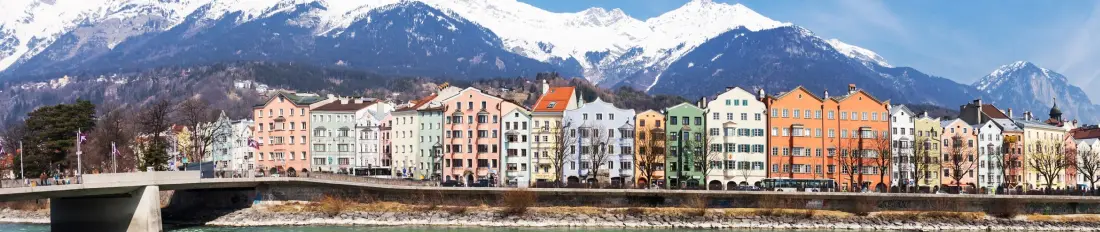
Innsbruck sits in the heart of the Austrian Alps, and it manages to be three things at once: a city of natural splendour, a storehouse of royal history, and a lively modern capital. It's the capital of Tyrol and one of Austria's most recognizable cities. Visitors come for the outdoor adventure and stay for the cultural elegance. The mountain backdrop does the rest, whether the season brings snow or sunshine.
The name means bridge over the Inn, a reference to the river that runs through the city, and the settlement's story goes back eight centuries and more. The Altstadt, or old town, is compact and lovely, with pastel facades, elaborate architecture, and cobblestone lanes that reward a slow walk. The Golden Roof, a late-Gothic oriel window built for Emperor Maximilian I in the 15th century, is trimmed with 2,657 fire-gilded copper tiles. It remains the city's imperial emblem, and it looks especially fine in late-afternoon light.
Habsburg influence turns up everywhere. The Hofburg Imperial Palace and the Hofkirche, whose Court Church holds Maximilian I's ornate tomb, both speak to Innsbruck's standing in the empire. Renaissance, Baroque, and Gothic influences overlap across the city, and the result is an architectural fabric that history-minded visitors tend to linger over. I'm not sure which architect signed off on the Hofkirche's nave, but the effect is unmistakable.
This is also a young town, not just a monument to the past. Universities and a large student body keep the city pulsing with inventiveness, and the bars, galleries, cultural events, and cafés give Innsbruck a contemporary vibe that sits comfortably beside its traditional appeal. Modern art galleries and music venues show the lively present. The Tyrolean State Museum and the Museum of Tyrolean Folk Art cover the region's history. I never made it to the folk art museum on my last visit, which gives me a reason to return.
For anyone who loves the outdoors, Innsbruck is close to paradise. The city hosted the Winter Olympics twice, in 1964 and 1976, and it remains a leading destination for skiing and snowboarding. The Nordkette cable car leaves from the centre and climbs to over 2,200 metres in about twenty minutes, where the views, ski runs, or mountain walks depend on the season. Summer brings mountain biking, climbing, and paragliding. In December the Christmas markets and snow-dusted rooftops turn the whole city into a winter wonderland.
The location also makes a fine base for exploring the wider Tyrolean Alps. Spectacular mountains, beautiful alpine lakes, and picturesque villages all lie within quick reach. Ambras Castle nearby and Swarovski Crystal Worlds in Wattens are popular day excursions that combine art, history, and natural beauty.
Culinary delights here reflect the mountain surroundings and the city's ethnic mix. Hearty Tyrolean dishes are the local favourites: Käsespätzle, Gröstl, and apple strudel, best savoured in friendly alpine taverns or on bright terraces with mountain views.
Innsbruck is a unique treasure where cultural depth meets alpine adventure. Whether the mountains or the palaces pull you in, the city invites you to explore, experience, and be inspired by its mix of nature and history.