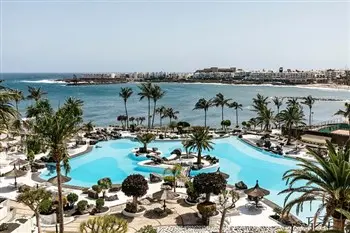
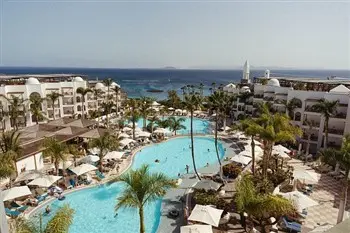
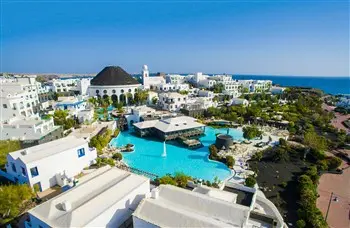
Playa Blanca sits at the southern tip of Lanzarote, and the five-star hotels along its seafront face a sheltered bay where the water stays calm enough for a morning swim well into November. The resort strip is compact. You can walk from the marina at Rubicón to the old town harbour in under forty minutes at an easy pace, and the beach at Playa Dorada shelves gently enough that you'll be standing in warm water up to your knees before you've noticed the drop.
What separates the best of these properties isn't scale. It's the way they handle the wind, which blows off the Atlantic most afternoons and can turn a sun lounger into a wrestling match. The resorts worth your money have designed around it: deep courtyards, glass screens, pools set behind low walls. You'll notice the difference the moment you step through reception and the air goes still.
Where to stay on the south coast
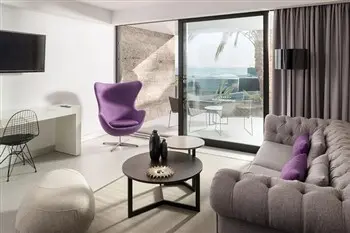
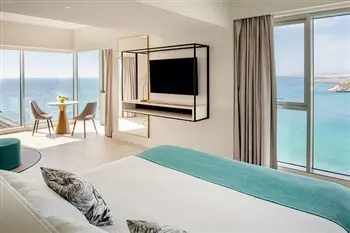
The larger hotels cluster around Papagayo, a stretch of protected coastline reached by a dirt track that takes about fifteen minutes by taxi from the main resort road. Several five-star properties run shuttle services down to the beaches there. If you're booking one of the beachfront suites, ask specifically for a room on the second floor or above, since ground-floor terraces tend to catch sand whenever the wind picks up.
Volcanic stone appears everywhere in the architecture, and it's not decorative affectation. The island's builders have used it for centuries because it holds heat through the evening and stays cool in the afternoon sun. You'll find it in the walls of the spa at one of the marina hotels, in the flooring around the main pool, and in the low garden walls that divide the villa plots. It gives the newer resorts a continuity with the older villages that Lanzarote's planners have guarded closely since the 1970s.
For dining, most of the five-star kitchens lean on Canary Island produce: goat's cheese from Fuerteventura, papas arrugadas with mojo, and fish landed at the harbour in the morning. The wine list is where Lanzarote surprises people. Malvasía grown in the volcanic ash of La Geria turns up on nearly every list, and the dry versions pair well with the grilled fish you'll find at the beachside restaurants.
- Book a sea-view suite rather than a garden room: the price difference at the marina properties is around €60 a night in high season, and the outlook is worth it.
- Half-board works better than full-board here; you'll want to eat out at least twice during a week.
- Ask about the adults-only sections, which most of the larger resorts operate as a separate wing with its own pool.
- Transfers from Arrecife airport take roughly thirty minutes by road.
What the top tier actually delivers
Standards across the island's five-star properties are consistent. Housekeeping is thorough, the concierge teams know the ferry timetables to Fuerteventura by heart, and the spa treatments use local aloe and volcanic salt rather than generic international product lines. You're paying for the setting as much as the service, and the setting holds up.
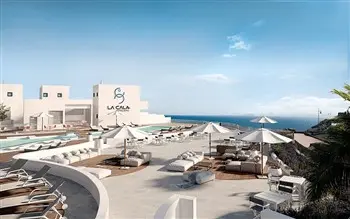
The private beach clubs are the clearest expression of this. Cabanas come with shade, towels, and a button for drinks, and the staff will bring lunch to you without any fuss. On the quieter stretches near Papagayo you can have several hundred metres of sand almost to yourself before mid-morning.
The best of these resorts understand that luxury on Lanzarote means working with the island's rhythms rather than against them.
Note that the island's protected status limits new construction, which is why the top-end portfolio is small. You're choosing from a handful of properties rather than dozens, and that scarcity is precisely what keeps the beaches from feeling crowded. The trade-off is that peak-season availability tightens early. Christmas and Easter book out ten to twelve months ahead, and the February half-term window is nearly as competitive.
Timing matters more than most people expect. The island's climate is mild year-round, with average highs of 22°C in January and 29°C in August. The calima, a dust-laden wind from the Sahara, blows through a few times a year and turns the sky a dull ochre for two or three days. It's rare in winter and unusual in summer, but it happens. You can't plan around it, and the hotels handle it well with indoor facilities and adjusted programmes.
The Worlds Top Luxury Resorts, Lanzarote edition
What elevates the Lanzarote properties within the broader category of The Worlds Top Luxury Resorts is restraint. There's no marble-and-gold excess here. The design language is whitewashed walls, dark timber, and the volcanic stone that gives the island its character. The service is attentive without hovering. You'll find that the concierge remembers your coffee order by the second morning, and the sommelier will steer you towards a local Malvasía rather than the obvious Bordeaux.
Guests tend to be a mix of British, German, and Spanish families, with a steady flow of couples drawn by the quiet. The atmosphere is relaxed. You won't find a dress code at dinner in most of the restaurants, though the formal dining room at one of the marina hotels does ask for smart casual after eight.
For the Exclusive 5* Luxury beach resorts in Lanzarote, the standard to judge against is the balance of privacy and access. Can you reach the beach in under two minutes? Is the pool quiet in the afternoon? Does the restaurant change its menu enough to keep a week interesting? The best properties here answer yes to all three, and they do it without making a performance of it.
One last practical point: the beaches at Papagayo are reached by a rough track, and hire cars are not always suited to it. The hotel shuttles run on a fixed schedule, usually every hour from nine in the morning until six in the evening. The walk down from the nearest resort gate takes about twenty-five minutes.