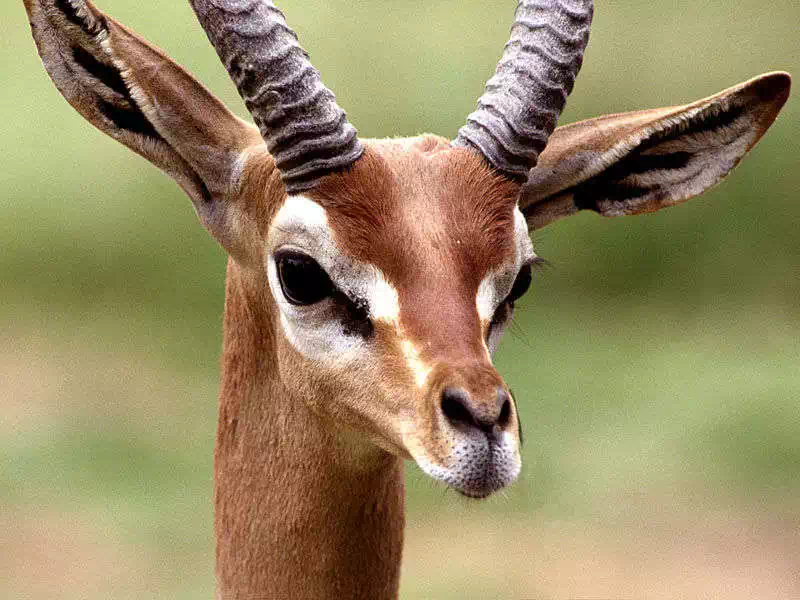
The Gerenuk (Litocranius walleri), also known as the giraffe gazelle due to its long neck and legs, is a distinctive antelope native to the arid and semi-arid regions of East Africa, including Central Kenya. This elegant animal is well-adapted to its environment, allowing it to survive in areas where food and water can be scarce.
Physical Characteristics:
Size and Build: The Gerenuk stands about 80–105 cm (31–41 inches) tall at the shoulder and weighs between 28–52 kg (62–115 pounds). Males are generally larger than females.
Neck and Limbs: Its most distinctive feature is its elongated neck, which, along with long, slender legs, gives the Gerenuk a unique, almost giraffe-like appearance. This adaptation helps it reach leaves and shoots on trees and shrubs that are inaccessible to other herbivores.
Coloration: The Gerenuk has a reddish-brown coat with a lighter underside. A black tuft of hair is present at the tip of the tail.
Habitat and Range:
Central Kenya: In Central Kenya, Gerenuks inhabit dry brushlands, savannas, and open woodlands, particularly in areas like the Laikipia Plateau and parts of the Samburu National Reserve.
Adaptations to Arid Conditions: Gerenuks are highly adapted to arid environments. They can survive without water for long periods, obtaining moisture from the vegetation they consume.
Diet and Behavior:
Diet: Gerenuks are browsers, primarily feeding on leaves, flowers, fruits, and buds from trees and shrubs. They often stand on their hind legs, supported by their elongated necks, to reach higher foliage that other herbivores cannot access.
Social Structure: Gerenuks typically form small groups, often consisting of females with their young. Males are more solitary, usually defending their territory from rivals. They are not highly social animals and are often seen alone or in pairs.
Reproduction: Female Gerenuks give birth to a single calf after a gestation period of about 7 months. Calves are hidden in thick vegetation for the first few weeks to protect them from predators.
Conservation Status:
Threats: The Gerenuk population is threatened by habitat loss due to agriculture, human settlement, and overgrazing by livestock. They are also vulnerable to hunting, although their habitats are often remote and less accessible.
Conservation Efforts: In Central Kenya, the Gerenuk is protected in several conservancies and national reserves, where efforts are made to preserve their natural habitat and protect them from poaching. The species is currently listed as "Near Threatened" on the IUCN Red List due to its declining population.
Interesting Facts:
Name: The name "Gerenuk" comes from the Somali word for "giraffe-necked."
Behavioral Adaptations: Unlike many other antelopes, Gerenuks do not need to drink water regularly, as they obtain sufficient moisture from their diet.
In Central Kenya, the Gerenuk is a fascinating example of how wildlife can adapt to survive in harsh and arid environments. It plays a critical role in the ecosystem by helping to control the growth of certain plant species, thus contributing to the overall health of its habitat. |