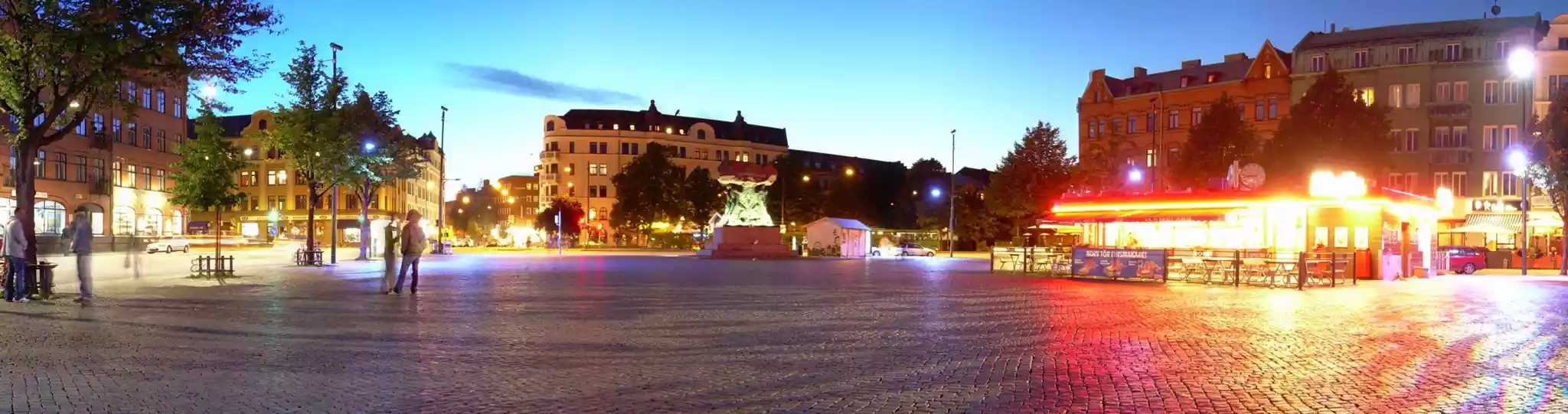
Malmö sits at Sweden's southern tip, and the rail crossing from Copenhagen over the Öresund Bridge takes about thirty-five minutes. The city suits a short break without ever demanding one. Flights come in directly at Sturup, or you can arrive from Denmark and step off the train into a compact centre where the main sights cluster within walking distance, and the pace runs noticeably slower than Stockholm's.
Stortorget, the main square, dates to the sixteenth century. On a sunny afternoon the cobblestones hold the warmth while the fountain catches the light, and above it all the old town hall presides with quiet patience. You'll likely come back more than once, maybe for coffee at one of the outdoor terraces, maybe just to watch the city go about its business. The square draws its share of cameras and guidebooks, yet it never tips into theme-park territory, because locals still cut through on bicycles and the shops along the edges sell fresh flowers and vintage records in equal measure.
A short stroll brings you to Lilla Torg, smaller yet somehow older in feel. Half-timbered houses lean in slightly, and in the evenings restaurants light candles until the whole square glows. It's a fine spot for dinner, whether you want traditional Swedish fare or something more international, and the atmosphere stays lively without tipping into rowdy. Gamla Väster, the old western quarter, rewards wandering without a map. Narrow streets, buildings painted in soft yellows and muted reds, and often the scent of cardamom drifting from a bakery.
The Turning Torso gives you Malmö from a different angle, and it twists into the sky in a way that looks almost impossible. You can't go inside without a specific reason, but the view from the surrounding Western Harbour area is striking at sunset, when the water turns silver. I'm not sure what the building's residents make of the constant photographing, but the silhouette never stops being strange and satisfying.
For somewhere to stay, the city punches above its weight. Reliable chains like Scandic and Clarion sit in the centre, clean and comfortable with that particular Scandinavian attention to detail. Boutique hotels have opened in recent years in converted townhouses, offering exposed brick, uneven floors, and breakfast rooms that feel like somebody's well-organised living room. Hostels are generally well kept, and a decent Airbnb in the city centre often costs about the same as a mid-range hotel elsewhere in Europe. The standard across the board runs high, and nobody seems to be cutting corners just because Malmö is smaller than Stockholm or Gothenburg. The Clarion's breakfast spread, in particular, runs to several kinds of herring and a formidable cheese board.
The quietest moment may stay with you longest. Walk through the grounds of Malmöhus Castle in Slottsparken, where the castle itself is worth a visit for the history and museums, but the gardens are where you should pause. Find a bench under one of the old trees near the moat, where the water lies still and green. The light filtering through the leaves slows you down without any decision on your part. You think about the morning in the square, the coffee, the walk along the harbour, and the medieval squares full of life and noise and good food, and sitting here in the green calm you feel you've actually arrived somewhere rather than just visited it. I lost a glove between the moat and the park gate and never found it. The bench I sat on had a small brass plaque with a name worn almost smooth.
Malmö doesn't shout for attention. It lets you stay a little longer, take another walk, order one more coffee. A short holiday could do worse. The last ferry to Copenhagen leaves at half past ten.

Exploring Malmo Sweden