What's to See and Do on Holiday in Kenya: A Guide
Most people asking what's to see and do on holiday in Kenya picture the same thing: a lion at dawn, a Land Cruiser with a popped roof, and a long lens. That picture is accurate as far as it goes, but Kenya is a country of roughly 580,000 square kilometres with a coastline, two highland cities, deserts in the north, and a lake system that turns pink with birds, so the honest answer is considerably longer than one game drive. A first trip usually runs ten to fourteen days, and the travellers who enjoy it most are the ones who split that time between the bush and at least one other landscape rather than stacking four reserves back to back.
The Masai Mara and the safari circuit
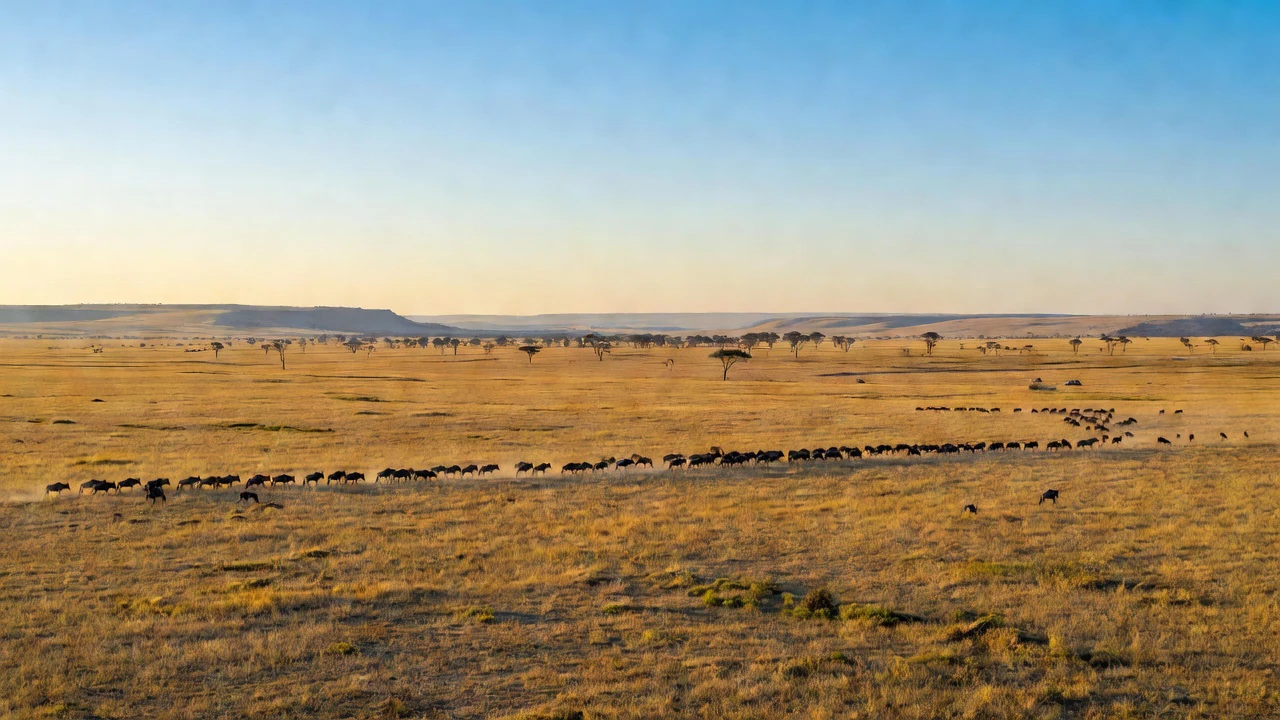
The Masai Mara National Reserve sits in the south-west, about 260 kilometres from Nairobi, and it remains the anchor of almost every itinerary. Entry for a non-resident adult costs around 200 US dollars per day in peak season, a figure that catches people off guard when they price up a week. The reserve is at its busiest between July and October, when the wildebeest herds cross from the Serengeti and the Mara River crossings draw queues of vehicles. Outside those months the grass is higher, the cats are harder to spot, and the whole experience is quieter and, frankly, more pleasant.
Amboseli, further south on the Tanzanian border, trades the Mara's river crossings for elephants against the backdrop of Kilimanjaro. The mountain shows itself maybe one morning in three; the rest of the time it hides behind cloud, and there isn't a thing a driver can do about that. Tsavo East and Tsavo West together form one of the largest protected areas in Africa, red with dust and far emptier than the Mara, though game densities are lower and a day there can involve long stretches of nothing but dik-diks and heat shimmer.
Up north, Samburu National Reserve offers species you won't find further south: Grevy's zebra, reticulated giraffe, gerenuk standing on their hind legs to browse. The drive from Nairobi takes six to seven hours on roads that deteriorate steadily after Isiolo. Most visitors fly instead, on the small scheduled services that hop between airstrips, which costs more but saves a day of your spine.
One thing worth saying plainly: a safari involves sitting in a vehicle for six to eight hours a day, often over corrugated tracks, and by the fourth morning the novelty of the 5.30 wake-up knock has worn off completely. People who expect constant action get restless. The long quiet stretches are the point, though, and the travellers who settle into them tend to be the ones rebooking before they've flown home.
Lakes, highlands and the places between the parks
The Rift Valley lakes sit conveniently on the road between Nairobi and the Mara, which is why so many itineraries include them. Lake Nakuru National Park is compact, fenced, and reliable for rhino, both black and white, often within the first hour of entering. The famous flamingo numbers have fluctuated for years with water levels, and some seasons the shoreline holds thousands while other seasons hold disappointingly few, so it's worth checking recent reports rather than trusting a brochure photo from 2011.
Lake Naivasha offers something different: boat trips among hippos and fish eagles, plus Crescent Island, where you can walk on foot among giraffe and zebra because there are no predators. Walking past a giraffe at thirty metres feels entirely different from photographing one through a window. Hell's Gate National Park, twenty minutes away, allows cycling and hiking between the cliffs, and the geothermal steam vents hiss away at the far end of the gorge. The park inspired some of the landscapes in a well-known animated film, or so the guides insist, though the connection is looser than they suggest.
Mount Kenya, Africa's second-highest peak at 5,199 metres, gets a fraction of Kilimanjaro's traffic. The trek to Point Lenana takes four to five days and doesn't require technical climbing, just lungs and a tolerance for cold huts. The mountain's lower slopes hold forest with colobus monkeys and, if you're fortunate, a melanistic serval, though sightings are rare enough that no one should plan around one.
Nairobi itself deserves a day rather than a hurried airport transfer. The David Sheldrick Wildlife Trust orphanage opens to the public for one hour daily, at 11am, when the baby elephants come in for milk and mud. The Giraffe Centre in Lang'ata lets you feed Rothschild's giraffes from a raised platform, and one of them will headbutt you gently if you hold a pellet in your lips, which is either charming or alarming depending on your feelings about large tongues. The National Museum is genuinely good and almost always half empty.
The coast: Diani, Lamu and the Swahili shore
Kenya's Indian Ocean coast runs for about 480 kilometres, and the sand is the fine white kind that squeaks underfoot. Diani Beach, south of Mombasa, is the most developed stretch, with resorts, kite-surfing schools and a strip of beach bars. The reef sits about a kilometre offshore, and at low tide the water retreats so far that swimming means a long wade, which frustrates people who arrived expecting to dive straight in.
Wasini Island, near the Tanzanian border, runs dhow trips to Kisite-Mpunguti Marine Park where dolphins appear on most outings and the snorkelling over the coral gardens is the best on the Kenyan coast. Lunch on the island is usually crab and coconut rice served at a long communal table. The dhows are wooden, slow, and leak a little; the crew bail without comment.
Lamu, further north, is the oldest continuously inhabited town in Kenya, a UNESCO-listed maze of coral-stone alleys where donkeys remain the main transport because cars can't fit. There are around 2,000 donkeys on the island, or possibly 3,000 depending on who's counting, and the donkey hospital near the seafront treats them free of charge. Shela village, a forty-minute walk along the shore, has the smarter guesthouses and a beach that stays empty even in August. The call to prayer drifts over the rooftops five times a day, and alcohol is available in Shela but not in Lamu town itself, a distinction that matters to some travellers and not at all to others.
Watamu, between Mombasa and Malindi, suits families: a protected marine park, calm lagoons, and a turtle rehabilitation project that releases rescued green turtles from the beach. Malindi has an older Italian expat presence, which means the pizza is inexplicably decent for a small East African town.
Practicalities that shape the trip
Getting around defines a Kenyan holiday more than any single sight. Domestic flights on the safari airlines run from Nairobi's Wilson Airport, a small, chaotic, cheerful airfield where the departure board is a whiteboard. A fly-in safari to the Mara takes about 45 minutes; the same journey by road takes five to six hours, the last two on murram that rattles the fillings. The Madaraka Express train between Nairobi and Mombasa takes around five hours, costs about 3,000 shillings in first class, and passes through Tsavo where elephants occasionally appear beside the tracks. It's clean, punctual, and the air-conditioning is set to a temperature best described as enthusiastic.
Costs deserve honesty. A mid-range lodge safari runs roughly 400 to 600 US dollars per person per night, full board with game drives included, and park fees come on top. Budget camping safaris from Nairobi can be had for around 150 dollars a day, but you'll be in a minibus with a pop-up roof rather than a Land Cruiser, and the tents are the kind you crawl into. The coast is cheaper: a decent guesthouse in Watamu might cost 60 dollars a night, and a plate of grilled fish with chips at a beach shack runs to about 800 shillings.
Health and paperwork: most visitors need an eVisa or eTA arranged online before travel, a yellow fever certificate if arriving from an endemic country, and malaria prophylaxis for the coast and low-lying parks. The highlands around Nairobi sit at 1,795 metres, cool enough in the evenings that a fleece isn't a ridiculous thing to pack for a trip to equatorial Africa. Tap water isn't for drinking. Bottled water is everywhere, and lodges provide it, though the plastic piles up in a way that sits uneasily with a conservation holiday.
Tipping is expected and the amounts add up: guides typically receive 10 to 15 dollars per guest per day, camp staff a similar amount pooled. Carry small US dollar bills, newer than 2006 series, because older notes are refused with a politeness that doesn't make them any more spendable.
When to go and how long to stay
The long rains fall from March to May, and some camps close entirely. The short rains in November are briefer and the dust settles beautifully, but grass grows fast and spotting gets harder. The dry seasons, January to February and June to October, offer the easiest game viewing and the highest prices. Christmas week on the coast books out months ahead with Kenyan families, which is a good sign rather than a bad one.
Ten days is the sensible minimum: four on safari, one in Nairobi, four on the coast, and a day lost to travel. Two weeks allows the northern circuit or Lamu without rushing. Three weeks, and you can add Mount Kenya or the far north, though the far north, Turkana and the Chalbi Desert, is expedition territory with distances measured in days and fuel stops measured in hope.
Solo travellers should know that single supplements on safari are steep, sometimes 50 per cent, and that joining a group departure from Nairobi cuts costs dramatically. Families are welcomed everywhere; Kenyans are genuinely fond of children, and lodge staff will entertain a bored seven-year-old with a patience that puts the average kids' club to shame. Honeymooners get the private dinners and the bed decorations, and the coast's boutique hotels do this well, though the word "exclusive" gets stretched thin in some brochures.
One small irritation worth naming: the plastic bag ban is real and enforced at the airport, so the duty-free carrier bag from your outbound flight may be confiscated on arrival, which is a strange way to start a holiday and a good policy nonetheless. Also, the Mara in peak season can mean forty vehicles around one leopard, engines idling, radios crackling. If that image bothers you, book a conservancy bordering the reserve, where vehicle numbers are capped and off-road driving is permitted. The conservancies cost more and deliver more.
Kenya rewards the traveller who treats it as a country rather than a backdrop. The wildlife delivers, reliably, but so does the train guard's announcement in Swahili and English, the smell of rain on dust at the first short-rains shower, the chapati from a roadside stand that costs 20 shillings and outclasses every flatbread you've paid ten times more for at home. Pack the fleece, book the conservancy, take the train at least one way, and leave a day unplanned at the end. The beach bar at the south end of Diani keeps a chalkboard of the day's catch, and the tamarind juice there is cold.
Further reading: Masai Mara on Wikipedia.