The Magic of Holidays in Kenya: Safari & Coast
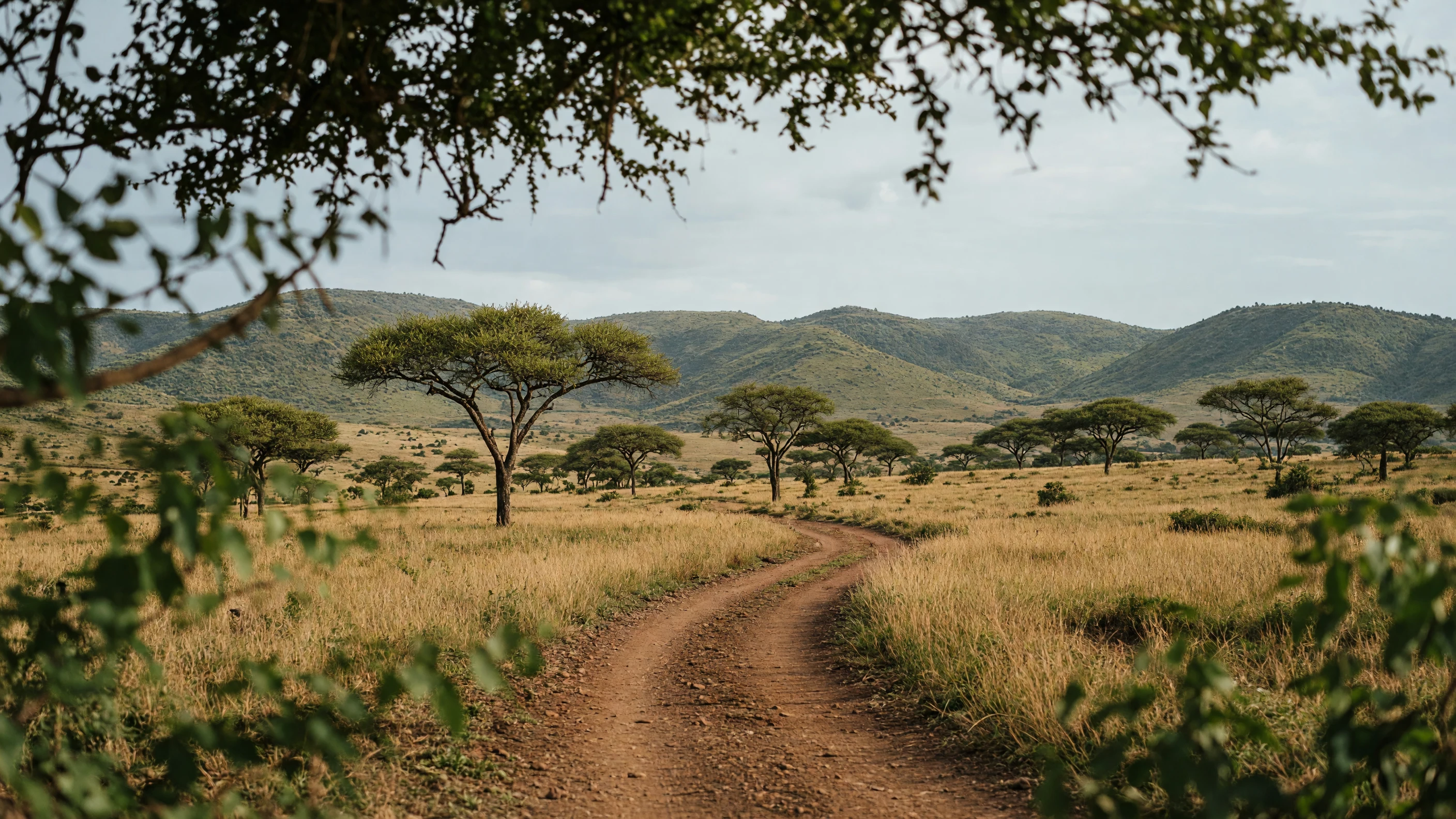
Kenya sits on the equator, and that single fact explains most of what happens to your sense of time there. Daylight arrives at six and leaves at six, give or take twenty minutes across the year, which means you eat breakfast in brightness and watch the sun drop behind the acacias while you're still holding a glass of something cold. The rhythm of a day here never feels rushed. You notice it by the second morning.
Most people land at Nairobi's Jomo Kenyatta airport after a night flight, bleary and slightly stunned, and are driven straight out of the city. The road north to the Aberdares climbs through coffee country, past smallholders' plots and roadside stalls selling sacks of potatoes, and the air cools by several degrees as you gain height. It's a gentle landing after the flight. You'll be asleep in your room by mid-afternoon with the window open and a blanket you didn't expect to need.
Why the magic of holidays in Kenya works on almost everyone
The country packs an unreasonable variety into a landmass about the size of France. You can be watching elephants cross a dusty pan at dawn, eating lunch at 2,100 metres in the shadow of Mount Kenya, and standing on a white sand beach by the Indian Ocean the following evening, all without a domestic flight longer than an hour. That compression is the thing people don't anticipate. Guidebooks tend to split Kenya into "safari" and "beach" as though they were separate countries. They're not, and the drive between the two is part of the pleasure.
You don't have to do it all. Plenty of visitors spend ten days in the Maasai Mara and leave perfectly content. But if you've got a fortnight, the mix is worth it. I'd say the split is closer to nine days on safari and four on the coast than the even half-and-half most itineraries suggest, though opinions differ sharply depending on who you ask.
What strikes you first, once you're out in the reserves, is the quiet. Not silence exactly. You'll hear a dove going on and on in a nearby thorn tree, the crunch of tyres on volcanic soil, the click of your own camera. The loudest sound is the absence of other engines.
Game drives follow a loose pattern. Early start, usually before six, because the light is best and the animals are moving. Back for a late breakfast around ten. A long middle of the day when it's too hot for anything much, which is when you read, swim, or sleep. Out again at four, back at seven, dinner at eight. Repeat. The repetition sounds dull written down and feels like a luxury in practice. Most guests settle into it by the third day.
The Mara is the obvious draw, and it earns the reputation. Between July and October the wildebeest move up from the Serengeti in numbers that are hard to picture until you've seen them strung across the horizon in a line that doesn't end. You'll get a sore neck from turning. Amboseli, further south and within sight of Kilimanjaro on a clear morning, is better for elephants: big family groups, calves tucked under their mothers, moving slowly across the dust. Samburu, north of the equator, is drier and stranger, with species you won't see elsewhere.
Don't overlook the conservancies bordering the Mara. They're privately managed, they limit the number of vehicles at a sighting, and the fees go directly to landowners who'd otherwise be running cattle. You'll pay a nightly conservancy fee on top of your accommodation, usually in the region of $100 to $150 per person per night. It's worth knowing about before you book. It rarely appears in the glossy brochures.
Sitting in an open vehicle at first light, with a coffee in a tin cup and nobody saying anything, is the closest thing to a reset I've found anywhere.
What a safari day actually asks of you
Patience, mostly. You can drive for two hours and see a herd of impala and nothing else, then round a corner and find a lioness with three cubs in the grass twenty metres away. The unpredictability is the point. Guides read the ground, the birds, the direction of the wind, and they're usually right, but not always.
Take the layers seriously. Mornings in the highlands can be 8°C in July, and by eleven you'll be in a T-shirt and wishing you'd brought a hat with a wider brim. Dust gets into everything: camera sensors, the folds of your scarf, the inside of your ears. Bring a cloth for the lens and don't bother with white trousers. Also worth packing: binoculars (borrow if you can, but bring your own if you have a pair), a headtorch for the walk back to your tent after dinner, and more memory cards than you think you need.
Some camps offer walking safaris with an armed ranger. These are excellent and underused. You see the small stuff at ground level: tracks, dung beetles, the particular shape of a whistling thorn. One morning we spent twenty minutes watching a pair of lilac-breasted rollers hunt grasshoppers. It sounds trivial and wasn't. I'd rank that hour above several of the bigger sightings, though I couldn't tell you why.
The balloon flights over the Mara cost around $500 per person at the time of writing and last about an hour in the air. You get a champagne breakfast in the bush afterwards, which is a bit of theatre, and a certificate. Worth it once. Not worth it twice.
You should know that not every camp is comfortable in the way you might expect. Tented accommodation is genuinely tented at the lower end, which means canvas walls, a shared bathroom block, and the sound of something large moving past your zipper at 3am. Bucket showers are common in the more remote spots: you ask for hot water and someone fills a tank outside and tells you when it's ready. It's a fine system. It just isn't a hotel, and if you're travelling with someone who needs a proper door and a lock, book accordingly.
There's also a hard limit to what you'll see. There's no guarantee of leopard, cheetah, or wild dog, no matter what your guide promises, and rhino numbers in some areas are so low that a sighting is genuinely a matter of luck. I went four days without seeing a single rhino on my first visit. The fifth morning we found two, a mother and a half-grown calf, standing in long grass about forty metres off the track. Nobody in the vehicle said a word for a while.
If you're wondering whether to bring children, the answer is yes from about seven upwards, provided you can manage the early starts and the long stretches of sitting still. Most camps have family tents and a guide who's good with kids. Many have a minimum age for walking safaris and balloon flights, usually twelve or sixteen. Check before you commit.
The coast, and why it belongs in the itinerary
Two hours by road or a short hop by air gets you to the Indian Ocean. The water is warm enough to walk into without flinching, which I realise sounds like a small thing and isn't. The reef keeps the swell down along much of the coast. You'll swim at high tide in water the colour of milky jade, then walk out at low tide across flats of exposed coral and seagrass where small crabs skitter sideways ahead of you.
Diani in the south and Watamu in the north are the obvious choices, though there's good diving off both. Snorkelling trips run from most beaches for around $40 per person, including the boat and gear. Equipment varies in quality. Check the mask fits before you get on the boat.
The Swahili coast has a history that predates almost everything else you'll encounter on the trip. Lamu Old Town has been continuously inhabited for over 700 years, and the carved doors alone justify the flight up. Stone Town in Zanzibar is a ferry ride from Mombasa if you want to extend. If you don't, Mombasa's own Old Town has plenty of crumbling coral-stone buildings, a fort, and a market that's been trading for centuries.
One practical note: the coast is hot and humid from December through March, and the long rains arrive in April and May, when many small hotels close entirely. June to October is dry and pleasant, and January to February is hot and clear. The ocean is swimmable year-round, though the reef can be rough in July and August.
Food along the coast is worth planning around. Grilled fish with lime and coconut rice, samosas from a roadside stall, a glass of fresh passion fruit juice with too much sugar. There's a place near the harbour road that does a crab curry for a few hundred shillings, and I've thought about it on and off for years.
Getting around, and the bits nobody warns you about
Internal flights are cheap and quick: Nairobi to the Mara takes about 45 minutes in a small Cessna, and you'll pay somewhere between $200 and $350 each way depending on the season. The planes are small, the luggage limit is usually 15kg in soft bags, and the strip you land on may well be a graded patch of red earth with a signpost. Nobody minds. The pilots are excellent and the views over the Rift Valley on a clear morning are worth the airfare on their own.
Driving between reserves takes longer than the maps suggest. The main roads are tarmacked and fine; the access roads into the parks are not. You'll spend an hour on a surface that shakes loose fillings. Nobody pretends otherwise. It's part of the trip.
Malaria tablets are advisable for the coast and the lower-altitude parks, and the highlands around Nairobi and the Aberdares are generally considered low-risk. See a travel clinic four to six weeks before you fly. Yellow fever certificates are required if you're arriving from certain countries, and the rules change. Check with your airline. The visa is straightforward: apply online in advance and print the confirmation.
The currency is the Kenyan shilling, and you'll get a better rate at a bank or an ATM than at the airport. Mobile money (M-Pesa) is used everywhere, and many small traders prefer it to cash. You'll need a local SIM card to use it, which costs about 100 shillings and takes ten minutes at a kiosk in Nairobi. Bring your passport.
People ask whether Kenya is safe. The reserves and the coast are as safe as anywhere, with the usual sensible precautions: don't walk around cities at night with your phone out, don't leave valuables in a parked car, and listen to your guide near wildlife. Standard stuff. The hospitality is the thing that stays with you. A guide who remembers your name on the third morning, a waiter who brings you mango without being asked because you mentioned you liked it on day one, a driver who pulls over to show you a chameleon on a branch because he thinks you'll want to see it.
Which you will. That's the honest answer to what's magic about a holiday here. It isn't the checklist of animals you tick off, though the checklist is genuinely spectacular. It's the accumulation of small kindnesses and unplanned moments that don't fit into an itinerary and can't be engineered. You can't plan for the chameleon. You can only be in the vehicle when the driver spots one and slows down.
Pack a spare pair of sandals if you're going to the coast. The reef has a habit of claiming one of them.
Further reading: Kenya on Wikipedia.