The Great Adventure of African Safaris: A First-Timer's Guide
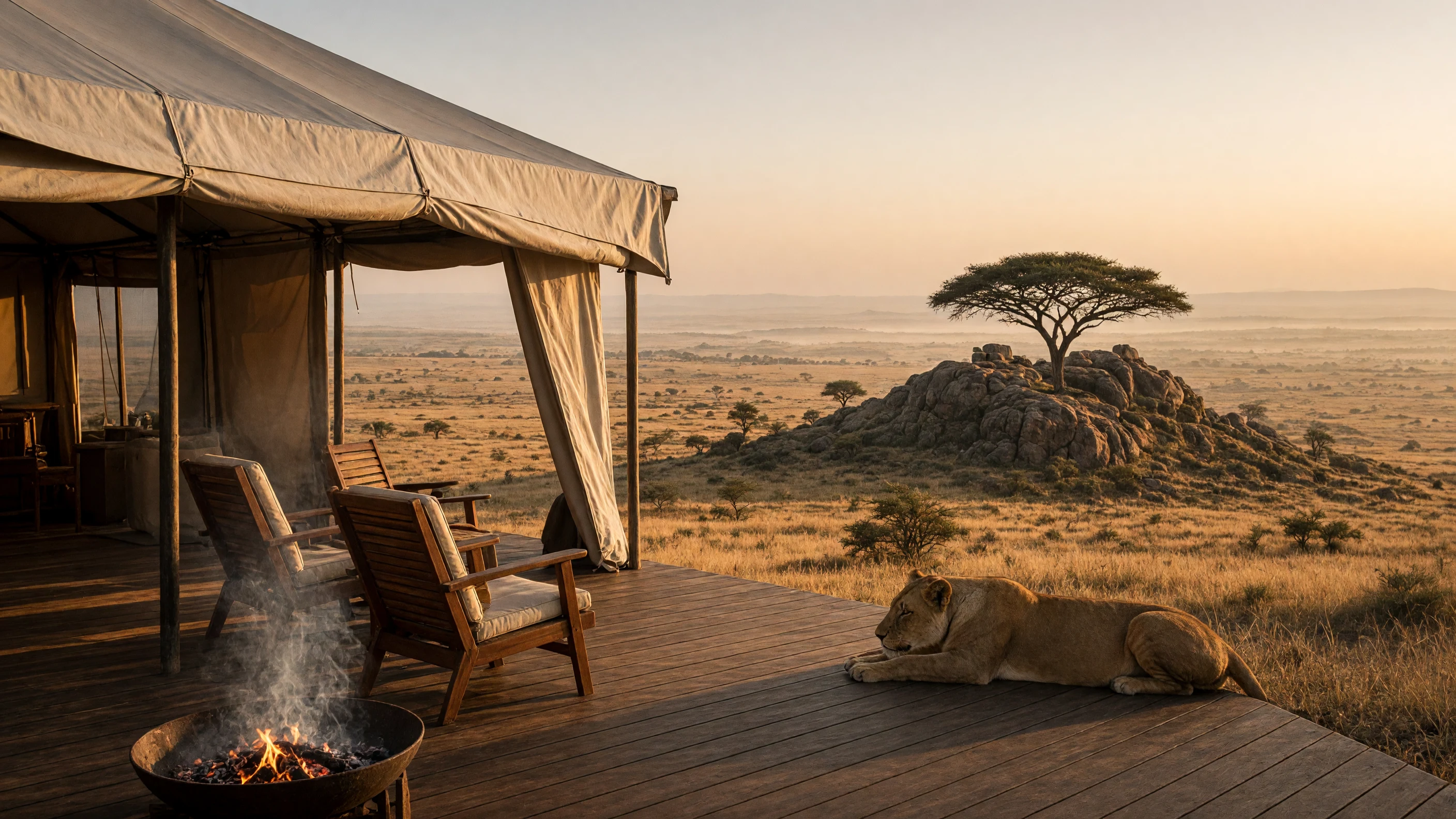
I flew into Kilimanjaro airport on a Tuesday afternoon in early February, with a duffel bag, a wide-brimmed hat I'd bought two days before, and a booking confirmation printed on four sheets of A4 because I hadn't trusted the wifi at home to hold. The great adventure of African safaris began, for me, in a car park in Arusha where a guide named Joseph loaded my bag into the back of a Land Cruiser and handed me a bottle of water that had gone warm in the sun. We drove west for three hours. Dust came through the vents, and by the time we reached the gate at Serengeti's Naabi Hill my forearms were the colour of the road.
What the great adventure of African safaris actually looks like on day one
There's a rhythm to it that nobody tells you about. You wake at five, drink coffee that tastes faintly of thermos, and sit in a vehicle for six hours. Somewhere in there a lion walks past close enough that you hear it breathing. You eat lunch from a metal box. Then you do it again the next day, and the next, and around the fourth morning you realise the sitting and waiting is the point rather than the tax you pay for the sightings.
Joseph had been guiding for eleven years. He could spot a cheetah at 400 metres off the road, and when I asked how, he said the tail gives it away before the body does. He was right. It always did. I tried it myself for a week and got it wrong about a dozen times before I got it right once.
We stayed in a tented camp on the central plains. Canvas walls, a bucket shower filled at six, a flush toilet that worked better than the one in my flat. The bed was comfortable. The generator went off at ten, and the silence afterwards was so complete I lay awake listening to it. Something moved through the grass near the tent wall around midnight. I don't know what it was and I didn't get up to look.
I'd expected the landscape to be greener. It was the short rains, everything should have been green, but the plains had dried out early and the grass was the colour of straw from horizon to horizon, broken by granite kopjes that stood up in low grey ridges. Is that the right image? Ridges, yes. Some of them hold rock hyraxes, which look like large guinea pigs and sound like someone screaming in the distance.
Mornings, and what you actually learn
Mornings are cold. I don't mean pleasantly cool. I mean the kind of cold that makes you zip a fleece up to your chin and wish you'd brought gloves, and then by half past ten you're in a T-shirt and the fleece is stuffed under the seat. Layering matters more than any piece of kit you'll read about online. A scarf pulled over your face keeps out the dust on the rough roads and doubles as a pillow on the long transfers.
You learn the animals in a way the documentaries never quite convey. Zebra foals stay on the far side of their mothers, so the mare is always between the foal and the road. Giraffes browse at dawn and again in the late afternoon, and in between they mostly stand and look at you with an expression I can only describe as mild disappointment. Elephants in the Serengeti have shorter tusks than the ones I'd seen in photographs from southern Africa, a legacy of decades of pressure. Joseph told me this without editorialising and I've thought about it since.
There are also, and I say this with affection, a lot of impala. Impala everywhere. Impala in the road, impala behind the impala, impala looking up from a bush with a mouthful of leaves. I stopped photographing them by day three and started photographing them again by day six. First excitement, then fatigue, then a slower and better kind of attention.
You stop counting the animals and start watching them. That's the shift. It happens around the fifth morning and it changes how you see everything afterwards.
The guides know things you can't google. Joseph could tell the age of a male lion by the darkness of his mane and the scar pattern on his face. He knew which leopard had cubs in the acacia near the river and he knew not to take us there, because she was denning and the mothers get stressed with vehicles. He told us why, plainly, and nobody in the vehicle argued. That restraint is a form of expertise and it's worth asking about when you book.
The Ngorongoro Crater, and a word about the crowds
We descended into the crater on a Thursday, down a switchback road so steep I braced a foot against the seat in front. The floor is 260 square kilometres of grassland and soda lake and it holds one of the densest populations of large mammals anywhere in Africa. It also holds, on that particular Thursday, forty-one other vehicles at the same lion sighting, lined up along the track in two long rows.
That's the trade-off. The crater delivers: black rhino at 200 metres, flamingos in a pink band along the shallows, a pride of seventeen lions working a herd of wildebeest in the middle distance. But it's a busy place, and I'd be lying if I said the queue of Land Cruisers didn't take something off the experience. The days I remember best were the quiet ones on the Serengeti plains, with no other vehicle in sight for an hour at a stretch.
We spent the night on the crater rim at around 2,300 metres and it was properly cold, cold enough that the camp staff brought hot water bottles to the table after dinner. I hadn't expected that and it made the whole evening. Rain came in around nine and drummed on the tent for two hours. I slept better than I had all week.
Practical things I'd tell a friend
- Binoculars are worth bringing. Sharing one between two people works for about an hour and then it doesn't.
- Take the yellow fever certificate if you're crossing from a country that requires it. I had it checked twice and I'd have been stuck without it.
- A dust-proof bag for camera gear saves a long afternoon of cleaning. The fine red dust gets into everything, including the lens threads.
- Cash in small notes for tips. Guides pool with trackers and camp staff, and the standard is around 10 to 15 dollars per guest per day for the guide and a separate amount for camp staff.
- Ask your operator about vehicle numbers at sightings. A good one will have a policy and won't be shy about it.
- Two pairs of worn-in walking shoes, not new ones. You'll be in the vehicle most of the day but the camps have paths and the paths have stones.
The other thing about kit is that less is more, genuinely. I took a 70-litre duffel and could have managed with 50. Laundry is cheap at most camps and the light aircraft that hop between airstrips have a hard 15-kilogram limit on soft bags. I watched a couple repack at the airstrip, hauling items from a hard-shell case into a duffel borrowed from the pilot, and it did not look like fun. Soft bags. Small ones.
On the flights between camps you get the country from above, and it's a different story entirely. Rivers that look like brown string. Herds spread out across the flats in their hundreds. The airstrip at Seronera is a strip of dirt with a windsock and a man in a chair who writes your name in a ledger. The pilot, a young South African woman, flew us at 500 feet over the Grumeti and pointed out a herd of elephant moving through the trees from the air, which is a view I've not had before or since.
What the safari does to the way you look at things afterwards
The great adventure of African safaris is not, in the end, the checklist. I saw the Big Five in the first three days, which is luck, and it didn't feel like the achievement I'd imagined. What stays with me is the sound a lion pride makes at four in the morning when they're calling to each other across the plains, a low repeated moan that carries for kilometres. I heard it three times and each time I sat up in the dark and listened until it stopped.
What stays with me is the way the light goes gold about forty minutes before sunset and everything in the grass stands out sharp against it. What stays with me is the guide's patience, and the way he'd stop the vehicle to show us a dung beetle rolling a ball twice its own size and wait while we watched. He was more interested in the beetle than in the lions, and by the end of the week so was I.
That's not a thing you can schedule. You can book the right camps and the right season and a guide with a good reputation, and you should, but the moments that matter happen while you're waiting for something else. I'd say the same about the whole trip. The planning took me four months and three drafts of a spreadsheet. The part I remember is sitting on a rock at dawn with a mug of tea, listening to a francolin call somewhere out of sight.
On the last morning Joseph drove me back to Arusha. We stopped at a roadside stall and he bought two mangoes, one for each of us, and we ate them standing up with the juice running down our wrists. He asked whether I'd come back. I said yes without thinking about it and I meant it.
The drive home took twenty-two hours door to door, including a four-hour layover in Doha. My hat didn't survive the trip, having been flattened under a bag in the overhead locker somewhere over the Gulf.